
Indie Author Academy / Lessons
IngramSpark returns explained: the hidden cost and risk
How IngramSpark returns work in November 2026: No vs Destroy vs Deliver, worked 50-copy chargeback maths, international shipping traps, and when to opt out.
IngramSpark returns are the single biggest financial trap in print-on-demand publishing. When you switch returns on, a bookshop can order dozens of copies of your paperback, display them for a quarter, and send unsold stock back to Ingram for a full refund. IngramSpark then charges you the wholesale price of every returned copy, even though you already paid the printing bill when the book was first manufactured.
As of November 2026, most self-published authors are better off leaving IngramSpark returns set to No unless they are running a funded bookstore campaign and holding a cash reserve for chargebacks. The arithmetic below explains why a single modest return can erase the profit from three or more genuine sales, and why choosing the wrong delivery option outside the United States can multiply your loss overnight.
How IngramSpark returns actually work
Traditional book publishing has run on a sale-or-return model for decades. A publisher ships cartons of books to a wholesaler or retail chain, the bookseller displays them for 60 to 180 days, and unsold copies return for credit. Large publishing houses price their catalogues and hold large cash reserves around return rates that routinely sit between 20% and 40% in physical retail.
When you upload a print title through IngramSpark global book distribution, you step into that same trade system. Ingram prints copies on demand when a retailer places an order, deducts the print cost and its 1.875% market access fee from the wholesale price, and pays you the remainder as publisher compensation. That initial payment feels like completed profit, yet it is conditional whenever returns are switched on.
If a bookstore later sends an unsold paperback back to Ingram, Ingram refunds the bookstore the full wholesale price it paid. Ingram does not refund your printing bill, because the paper, ink, and binding were already used. Instead, Ingram charges the entire wholesale price back to your account on the date the return is processed. You lose the original royalty, you keep zero payment for the print cost you funded, and you end up out of pocket by more than the cost of printing the book.
The three IngramSpark return settings compared
Inside your IngramSpark title setup, you pick one of three return statuses for each market. Verify the latest policy wording inside the IngramSpark help centre before publishing; note also that IngramSpark removed its old $25 file revision fee for updates made more than 60 days after publication.
| Return setting | What happens to unsold copies | Cost charged to you per return | Bookshop willingness to stock shelves |
|---|---|---|---|
| No (non-returnable) | Retailer cannot return unsold stock to Ingram | $0 (no returns accepted) | Low for speculative shelves; fine for online listings and special orders |
| Yes - Destroy | Returned copies are pulped or recycled by Ingram | Wholesale price on the date processed; no shipping fee | Standard trade expectation when paired with 53% to 55% discount |
| Yes - Deliver | Returned copies are posted back to your address | Wholesale price plus roughly $3/book (US) or roughly $20/book (non-US) | Same trade acceptance as Yes - Destroy |
The physical bookshop sees only a returnable flag in Ingram's catalogue; choosing Destroy or Deliver changes only what happens after Ingram receives the copy and how much shipping leaves your account. Setting returns to No still allows online stores such as Barnes & Noble online and Waterstones online to list your book for print-on-demand fulfilment. For a full comparison with Amazon print, read our lesson on IngramSpark vs KDP for indie authors.
Worked example: what a 50-copy return costs you
This worked example illustrates the arithmetic on a hypothetical 300-page paperback priced at $16.00 with a 55% trade discount, a $4.60 print cost, and IngramSpark's 1.875% market access fee calculated on list price.
- Wholesale price paid by the trade channel (45% of $16.00): $7.20 per copy.
- IngramSpark 1.875% market access fee on $16.00: $0.30 per copy.
- Assumed print cost on IngramSpark print-on-demand: $4.60 per copy.
- Initial publisher compensation per shipped copy: $7.20 minus $4.60 minus $0.30 = $2.30.
Suppose a regional chain orders 50 copies for a seasonal table display, generating 50 multiplied by $2.30 = $115.00 in initial compensation. Look at what happens four months later under two outcomes.
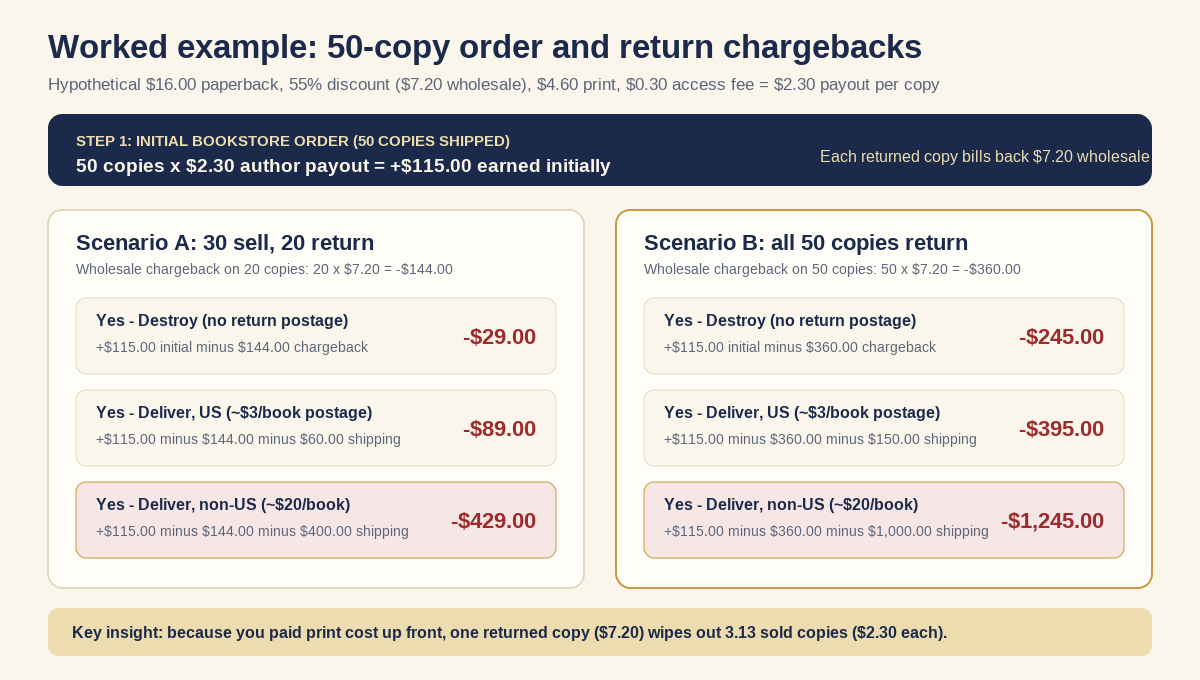
Scenario A: 30 copies sell and 20 copies return
Selling 60% of a display order sounds encouraging, yet the return chargeback on 20 unsold books is 20 multiplied by $7.20, equalling $144.00. Even with 30 genuine reader sales, Yes - Destroy leaves a net loss of $29.00 ($115.00 minus $144.00). Adding roughly $3.00 per book for US Yes - Deliver postage ($60.00) widens the loss to $89.00. Leaving non-US Yes - Deliver active at roughly $20.00 per book ($400.00) turns the order into a $429.00 loss.
Scenario B: all 50 copies return
Full returns happen when an event cancels, a buyer changes roles, or a chain runs an automated inventory sweep. On 50 returned copies, the wholesale chargeback is 50 multiplied by $7.20 = $360.00. After offsetting the initial $115.00 payout, Yes - Destroy leaves a $245.00 net loss. US Yes - Deliver adds $150.00 in postage for a $395.00 loss, while non-US Yes - Deliver adds $1,000.00 for a $1,245.00 net loss. Because one returned copy bills back $7.20 while one kept sale pays $2.30, each single return wipes out 3.13 sold copies; roughly 76% of shipped copies must stay sold just to break even.
The international Yes - Deliver fee trap
Many authors in the UK, Canada, Europe, and Australia tick Yes - Deliver because pulping books feels wasteful. As of November 2026, IngramSpark's non-US return delivery fee sits at roughly $20 per book on top of the wholesale chargeback. Printing a fresh 300-page paperback locally usually costs £4 to £7 per copy, so paying $20 to recover a shelf-worn, price-stickered copy from a US warehouse costs three to four times more than ordering clean stock.
Even inside the US at roughly $3 per book, Yes - Deliver pays off only if returned copies arrive clean enough to resell at events. To sell physical stock direct at full profit, order fresh cartons and follow our guide on how to sell signed paperbacks direct from your website.
Why returns create surprise negative invoices
Return chargebacks hurt twice because of timing. IngramSpark typically pays publisher compensation around 90 days after the sale month. A January order might pay out in April, and unsold copies returned in July are deducted from July earnings. In Scenario B above, if July sales are zero, your account does not stop at zero; it drops to minus $360.00 under Yes - Destroy, or minus $1,360.00 under non-US Yes - Deliver, creating a balance you must settle.
A second timing trap appears when you raise your list price. IngramSpark calculates chargebacks using the wholesale price active on the date the return is processed, rather than the original shipment date. Raising your price while returnable copies sit on shop shelves increases your chargeback per copy if they come back later. Check your pricing margins carefully with our guide to how to price your book before launching any trade campaign.
When to turn IngramSpark returns on or off
Deciding whether to accept returns should follow a strict checklist rather than hope. Organisations such as the Alliance of Independent Authors advise indie writers to weigh trade returnability against actual marketing reach before ticking the box.
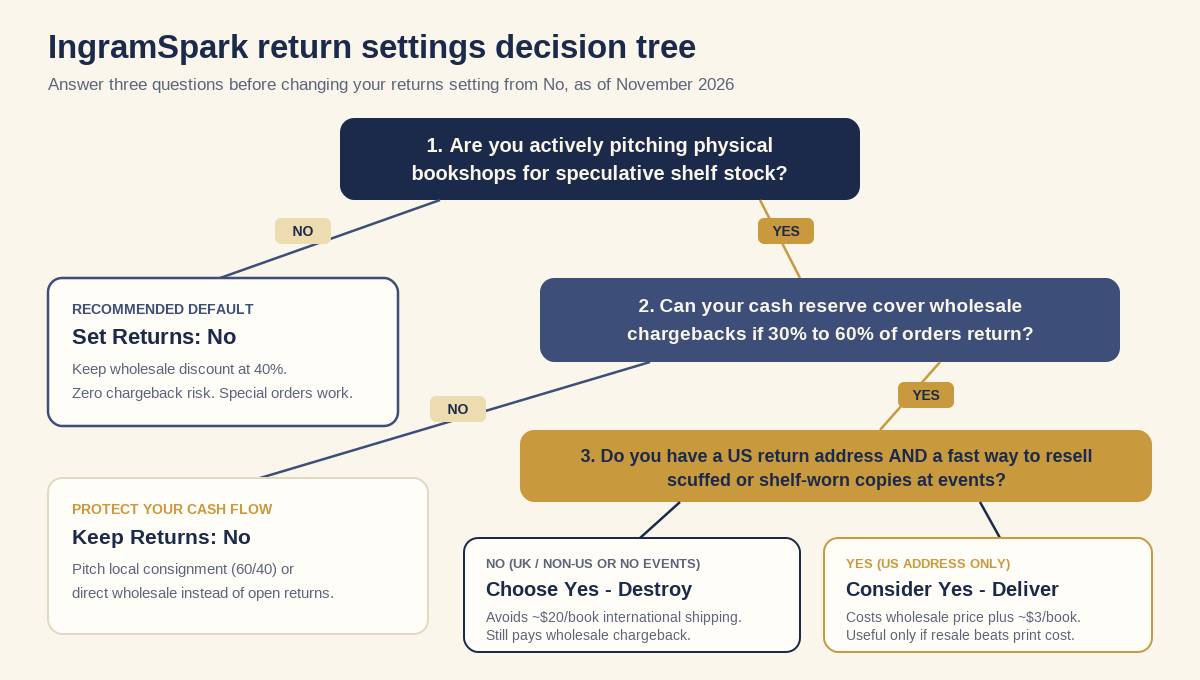
Keep returns switched to No in the following situations:
- You sell primarily online via Amazon, direct website orders, and digital storefronts, with no active physical bookstore outreach plan.
- You are publishing a debut book or testing a new series and cannot afford an unexpected $300 to $1,500 invoice six months after launch.
- Your paperback retail price is tight against the print cost, leaving under $2.00 per copy at a 55% discount.
Consider enabling Yes - Destroy temporarily only when all four conditions hold at once:
- You have a scheduled regional media push, speaking tour, or confirmed bookstore buyer requesting trade returnability through Ingram.
- You have set a cover price high enough to leave a healthy per-copy margin even at a 53% to 55% trade discount.
- You have set aside a ring-fenced cash reserve equal to at least 50% of the wholesale value of any bulk order you expect to pitch.
- You review your IngramSpark compensation and return reports every month so you spot unusual ordering spikes early.
Remember the 180-day tail if you later turn returns back off. Switching a title from Yes back to No protects future orders, while books already in transit or sitting in a shop warehouse can still be returned for up to six months. Keep your cash reserve untouched until that full window has cleared.
Safer ways to handle bookstore risk without open returns
Turning IngramSpark returns to No does not lock you out of physical bookshops. You have three practical alternatives that put your paperback into readers' hands without signing a blank cheque to national wholesalers.
First, leave IngramSpark set to a 40% wholesale discount and returns set to No so every bookshop in the country can place special customer orders when a reader walks in and asks for your title. Because a paying customer is already waiting for the copy, the shop has no need to return it. Second, approach independent bookshops within driving distance for local consignment on a standard 60/40 split. If five copies sit unsold after 90 days, you drive over, collect your clean books, and owe nobody a chargeback.
Third, supply confirmed launch events and specialist retailers through direct wholesale at 40% to 50% off cover price, paid on invoice as a firm sale. Before ordering any author copies or uploading updated print files, verify your trim size and spine math with our KDP and IngramSpark print specs guide so every copy arriving at a shop looks clean and professional. Log into your IngramSpark dashboard today, check the current return setting on every active ISBN, and confirm that no title is sitting on Yes - Deliver by mistake.
Questions, answered
How much does IngramSpark charge when a book is returned?
IngramSpark charges back the full wholesale price of the book on the date the return is processed, which is the list price minus the wholesale discount. If you selected Yes - Destroy, there is no extra shipping charge. If you selected Yes - Deliver, you also pay roughly $3 per book to a US address or roughly $20 per book to a non-US address.
Can IngramSpark send me a negative invoice if returns exceed my sales?
Yes. Return chargebacks are deducted from your publisher compensation in the month Ingram processes the return, which often arrives months after the original sale. If your return charges exceed your monthly earnings, your account goes into a negative balance that IngramSpark can invoice to you.
If I switch IngramSpark returns from Yes to No, am I protected straight away?
No. Changing a title from returnable to non-returnable stops future wholesale orders from carrying return rights, yet copies already shipped to retailers remain eligible for return during a standard trade window of up to 180 days. You remain financially responsible for copies ordered while returns were turned on.
Should UK or European authors ever choose Yes - Deliver on IngramSpark?
Almost never. Returning physical paperbacks to a non-US address through IngramSpark costs roughly $20 per book on top of the wholesale chargeback, which is far higher than printing a brand-new author copy locally. International authors who genuinely need returnability should pick Yes - Destroy instead.
Will my paperback still appear on online stores if IngramSpark returns are set to No?
Yes. Major online retailers such as Waterstones online, Barnes & Noble online, and Bookshop.org list non-returnable IngramSpark titles for print-on-demand fulfilment, and physical bookshops can still place special customer orders at the counter. Setting returns to No mainly affects speculative shelf orders placed by physical stores.