
Indie Author Academy / Lessons
Book marketing in the age of AI: what still sells books
Book marketing in the age of AI favours owned email lists, real reader reviews, clear author websites, direct sales and human proof over automated spam.
Book marketing in the age of AI has changed where readers discover new titles and what makes them trust a stranger's book enough to pay £4.99 or £12.99. As generative search summaries answer routine queries directly on the results page and automated content floods social feeds and low-effort retail categories, generic promotion produces shrinking returns. What still sells books reliably in late 2026 are assets software cannot easily fake: an owned email list, recognisable human voice, verified reader reviews, a clear author website and direct buyer relationships.
You do not need to panic about technology or chase every new AI tool to keep selling books. Instead, shift your weekly marketing hours away from high-noise tactics that algorithms already discount and invest in verifiable human trust signals that compound with every book you publish.
How book marketing in the age of AI has changed reader discovery
Three practical shifts have reshaped digital book discovery as of November 2026. First, search engines now place AI-generated overview blocks above traditional blue links on broad informational queries. If a reader searches for general background trivia on a historical period or writing topic, they often read the summary and never click a blog post. When a reader searches specifically for your author name, your series reading order or books similar to an author they already love, clear structured pages still win clicks and citations.
Second, low-effort automated publishing has flooded open marketplaces with thin nonfiction guides, synthetic summaries and unedited fiction. Readers have noticed. Surveys and commentary across indie-publishing groups such as the Alliance of Independent Authors and The Authors Guild reflect growing reader scepticism towards anonymous books that lack clear human provenance. Readers who used to click buy on an appealing cover alone now check author pages, sample chapters and recent reviews more carefully before spending money.
Third, social media feeds are saturated with synthetic images, AI-drafted captions and automated engagement comments. Platform algorithms struggle to separate real human writers from automated accounts, so passive organic reach for generic book graphics has fallen sharply. Paid discovery channels tracked by industry marketers such as Written Word Media still move copies when targeted cleanly to genre readers, yet rising competition means converting every new buyer into a repeat reader matters more than ever.
Why generic SEO blogs and automated social feeds are losing ground
For years, standard advice told debut authors to publish weekly 600-word blog posts about writing tips and schedule five daily promotional tweets with book mockups. That playbook was already tiring; in 2026 it rarely pays back the hours it consumes.
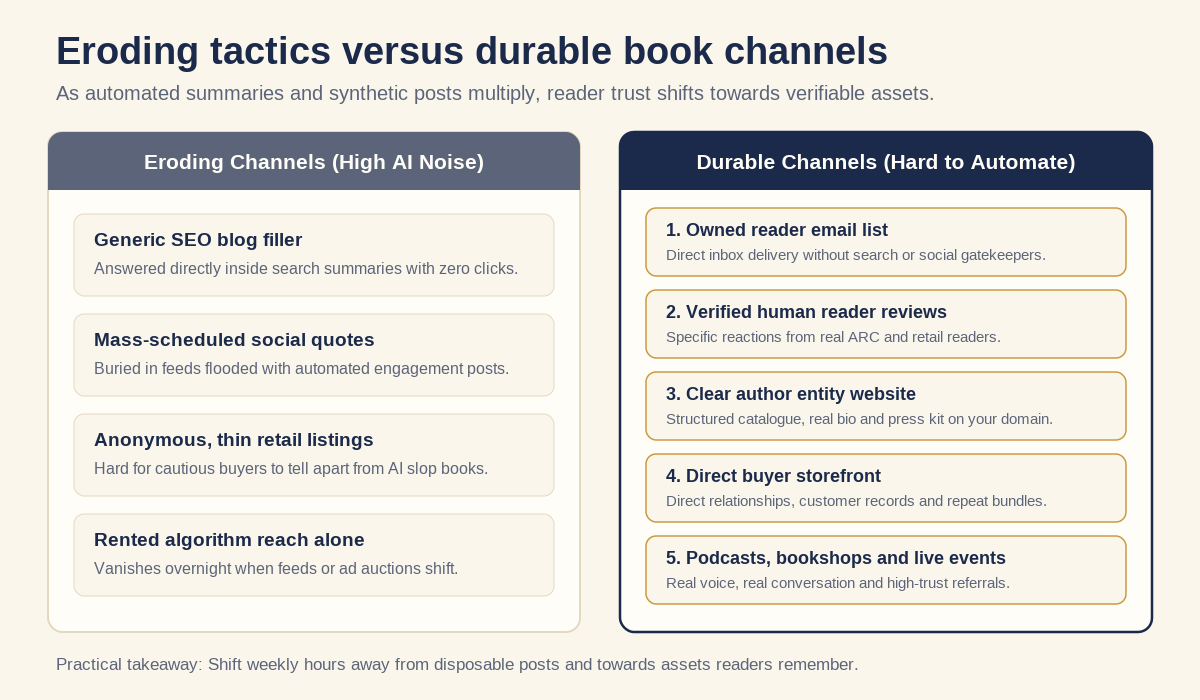
- Generic informational articles compete directly against instant search summaries and thousands of machine-generated clones saying the exact same thing.
- Automated social quote cards look identical to spam accounts, training readers to scroll straight past promotional graphics without pausing.
- Mass-generated ad copy filled with generic superlatives lowers click-through rates because readers recognise machine-phrased blurbs immediately.
- Anonymous pen names with zero web footprint and a single bare retail listing resemble automated content farms, costing real human authors sales they deserved to win.
Stopping low-return busywork frees up several hours a week. The question is where to put those hours so your books keep selling over the next five years.
Five durable book-marketing channels AI cannot easily commoditise
Durable channels share one trait: they rely on verified permission, real human voice or first-hand reader proof that cannot be mass-produced overnight.
1. An owned reader email list
Email sits outside search summaries and social media feeds. When a reader finishes your novel, enjoys your voice and voluntarily types their email address into your signup form, they have given you direct permission to arrive in their inbox when the next book launches. Short, plain-text letters written in your genuine voice outperform glossy automated templates because readers feel a real person sitting on the other side of the message. If you are starting from zero, our guide on getting your first 100 email subscribers with no ad budget sets out the fastest practical steps.
2. Verified human reader reviews
Detailed reviews written by real readers who quote a scene, mention a character's flaw or explain why a nonfiction framework saved them time carry immense weight in an AI-sceptical market. Building a small, reliable advance-reader team from your own mailing list guarantees that launch week opens with authentic, specific reader reactions rather than silence. Authentic reviews also feed recommendation engines and AI book-suggestion tools, which frequently summarise recurring themes from genuine reader feedback.
3. A clear author entity website on your own domain
When a reader hears your name on a podcast or sees your book recommended in a chat summary, their very next move is typing your name into a search box. Your own website should appear first and answer every question cleanly: who you are, what genre you write, the exact reading order of your series, ISBNs, sample pages and where to buy. Our guide to the six pages worth building for an author website shows how to keep that site fast and focused.
4. Direct sales and reader relationships
Selling ebooks, bundles or signed paperbacks directly from your website turns anonymous store transactions into known reader relationships. You see who buys every release, you keep customer records safe from store policy shifts and you can reward repeat buyers with early chapters or collector editions. Knowing exactly what you own independent of retail logins is covered in if Amazon closed your KDP account, what you still own.
5. Podcasts, local bookshops and live reader events
Audio interviews, reader panels, library talks and indie bookshop signings are almost impossible to automate convincingly. A twenty-minute podcast conversation lets listeners hear your real voice, humour and deep knowledge of your book's subject. One well-matched niche podcast appearance often sells more copies over twelve months than a hundred scheduled social graphics, because listeners arrive already trusting the person behind the cover.
Making your author website legible to both readers and search engines
Good search hygiene in 2026 is simpler than old-fashioned keyword stuffing. Following the fundamentals in the Google Search Central SEO Starter Guide helps both traditional search results and AI overview systems understand your books accurately without guessing.
Give every book its own permanent URL containing the book title, write a clear plain-English summary stating the genre, setting, series number and comparable tone, list every format and ISBN cleanly, and link consistently between your homepage, author bio, press kit and official retailer profiles. Avoid hiding key book details inside image-only banners that crawlers cannot read. You can walk through the technical checklist in our search basics for an author website guide, or review clean page structures on our author website builder page.
Comparing fragile tactics against durable author assets
Use this comparison table when deciding whether a marketing task deserves space on your weekly calendar.
| Marketing activity | Exposure to AI saturation | Shelf life of one hour's effort | Practical verdict for 2026 and 2027 |
|---|---|---|---|
| Writing generic top-10 blog filler | Very high (replaced by search summaries) | Low (declining click share) | Drop unless writing a genuine original resource |
| Auto-scheduling daily book-quote graphics | Very high (drowned in synthetic feeds) | Hours | Replace with fewer, human-voiced updates |
| Updating book back matter and email welcome sequence | Very low (owned permission channel) | Years across every new reader | High priority; check every quarter |
| Maintaining a clear author site and press kit | Low (verifies human entity and books) | Years | Essential baseline for every indie author |
| Pitching 3 niche podcasts or book clubs a month | Very low (real voice and conversation) | Months to years of archive listeners | High trust return per hour spent |
| Recruiting and thanking a real ARC review team | Low (specific verified reader proof) | Permanent retail social proof | Repeat before every new launch |
A five-point human-trust audit for your website and retail pages
Set aside 90 minutes to inspect your books and website through the eyes of a cautious 2026 reader who has been burned once by a low-effort AI book and now checks before buying.
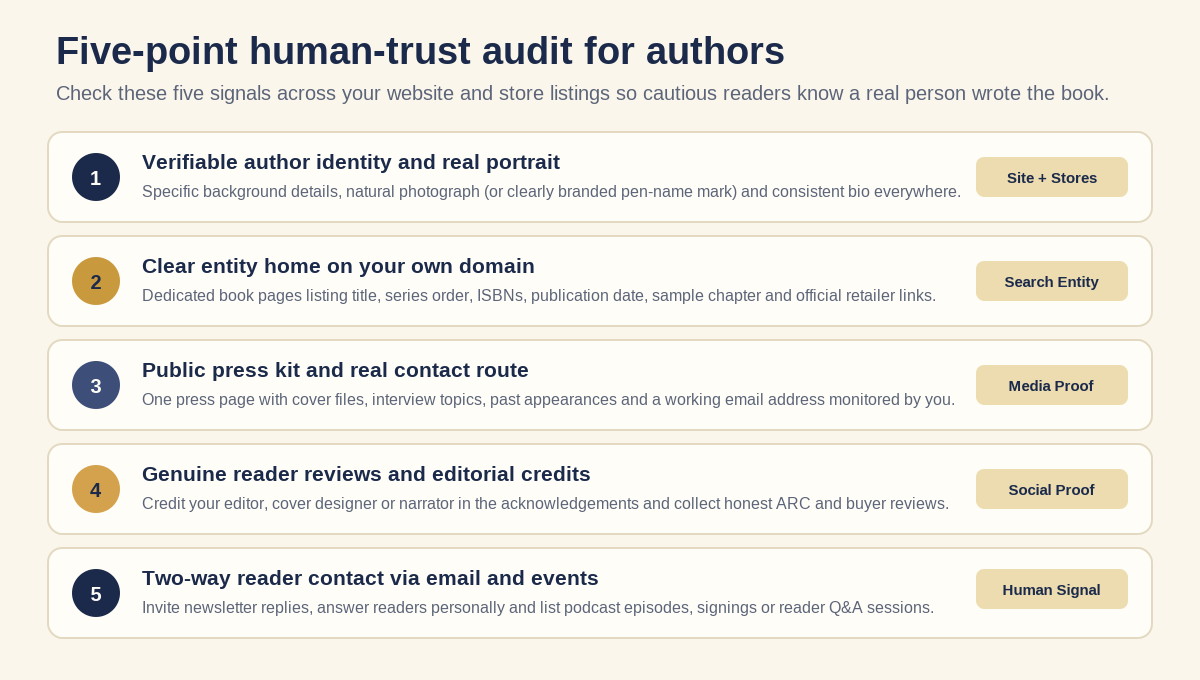
- Audit your author identity and portrait: replace vague stock phrasing with two concrete real-world details (your region, profession, research interest or writing background) and use one clear, natural author photograph. If you write under a private pen name, keep your branding, consistent voice and domain identity unmistakable so readers still recognise a real human creator.
- Audit your book pages for entity clarity: confirm every title on your website displays its series order, publication date, ISBNs, clean blurb, readable sample excerpt and working buy links to both your direct shop and major stores.
- Audit your press kit and contact path: publish one dedicated press page with downloadable covers, three bio lengths, past interviews and a working email address. Podcasters, journalists and festival bookers treat a ready press kit as immediate proof of a serious working author. See our template walkthrough in what to include in an author press kit and our author press kit overview.
- Audit your editorial transparency and reader reviews: credit your real human editor, proofreader, cover designer or audiobook narrator in your acknowledgements page, and check that your retail sample (first 10 percent of the book) reads cleanly with zero formatting glitches.
- Audit your two-way reader contact: check that your newsletter welcome email invites readers to hit reply with a simple question, and make sure you answer genuine reader emails personally. Real replies train inbox providers to keep you out of spam folders and turn quiet subscribers into vocal advocates.
If you want to manage those core owned assets (author website, mailing list, direct ebook shop, ARC delivery and press kit) inside one flat-fee dashboard instead of maintaining five disconnected subscriptions, Indie Author Toolchest includes all of them at $12.99 a month or $120 a year with a 14-day free trial and no card required, and direct sales switch on when you subscribe.
Where to spend your weekly marketing hours in 2026 and 2027
Suppose you have four hours a week for marketing alongside your writing schedule. Rather than scattering those hours across six social networks, divide them cleanly across four durable habits:
- One hour on your mailing list: draft a genuine reader letter, answer subscriber replies or refine your welcome sequence and back-matter invitation.
- One hour on human outreach: pitch one relevant podcast, arrange one local bookshop or library conversation, or follow up with your ARC team.
- One hour on your catalogue and website: keep book pages, reading orders, press kit links and direct bundles tidy and accurate.
- One hour on measured discovery: review ad spend or genre promo slots against actual read-through and email sign-ups, cutting anything that does not pay back.
Book marketing in the age of AI rewards clarity, patience and visible human craft. Keep writing books readers genuinely finish, make it easy for strangers to verify you are a real author on your own domain, and bring every reader you earn onto an email list no algorithm can take away.
Questions, answered
Has AI killed SEO for indie author websites?
Generic informational blog posts get fewer clicks now because search summaries answer broad questions directly on the results page. Branded searches for your author name, book titles, reading orders and series pages still drive high-intent readers straight to your website, which makes clear author entity pages more valuable than filler blog articles.
How do readers tell human-written indie books apart from AI-generated books?
Cautious buyers look for consistent proof outside the store listing: a real author website on an owned domain, a specific human bio, genuine detailed reader reviews, professional cover design and visible credits for editors or narrators. Anonymous listings with stock bios and thin web footprints raise immediate suspicion.
Should indie authors stop using social media to promote books in 2026?
You do not need to quit social media completely, though mass-scheduling generic quote graphics rarely moves books any more. Pick at most one platform where you can show real human personality through short videos or direct reader replies, and always guide interested followers back to your own email list.
Do AI book-recommendation tools pull data from author websites?
Yes. Generative search engines and chat-based recommendation tools cross-reference retailer listings, reader reviews and official author websites to verify tropes, series order and publication details. Keeping clean, plain-text book pages with accurate ISBNs, genres and blurbs on your own domain helps both search engines and AI summaries describe your catalogue accurately.
What is the single best marketing asset an indie author can build right now?
An owned reader email list backed by a clean author website and direct book storefront remains the strongest asset you can control. Neither search summaries nor social media algorithm shifts can block a plain email landing directly in the inbox of a reader who enjoyed your previous book.