
Indie Author Academy / Lessons
Amazon review prompts versus running your own ARC team
Compare Amazon review prompts against an author-run ARC team on launch velocity, timing control, reader ownership, cost per review, and KDP policy compliance.
Amazon review prompts and an author-run Advance Reader Copy (ARC) team solve two different stages of a book's life. Automated post-purchase prompts run passively inside Amazon's ecosystem and slowly collect ratings from organic buyers weeks after release, with zero timing or targeting control for the author. A compliant ARC team puts free advance copies into the hands of opt-in genre fans two to four weeks before launch so honest reviews land during week one.
As of November 2026, Amazon continues to enforce strict anti-manipulation rules against paid reviews, review swaps, and incentivised ratings while testing automated buyer review nudges inside its own storefront. Relying exclusively on those platform prompts leaves a brand-new book sitting at zero reviews during its critical launch window. Pairing your own compliant ARC team with Amazon's passive prompts gives you launch-week social proof plus steady long-term momentum.
How Amazon review prompts actually work for buyers
Amazon deploys several native nudges designed to encourage verified buyers to rate or review books they have already bought. The most visible is the automatic end-of-book rating screen on Kindle devices and reading apps, which asks a reader to tap one to five stars the moment they finish the final chapter. Amazon also sends occasional post-purchase reminder emails and has tested automated buyer prompts and ad-style nudges reminding past purchasers to share a rating.
Every one of those prompts is controlled entirely by Amazon's algorithms. As an author, you cannot schedule when a buyer sees a reminder, select which past customers receive a nudge, inspect click-through rates on the prompt, or follow up with readers who loved the book. Because a shopper must first discover your book, buy it, find time to read it, and feel moved to tap a star rating, passive prompts cannot solve the zero-review bottleneck on launch day.
All customer ratings and written reviews on the storefront are governed by the Amazon KDP Customer Reviews and Community Guidelines alongside the broader Amazon KDP Content Guidelines. Amazon's automated filters monitor review velocity, account connections, and suspicious incentive patterns closely, and they can strip reviews or suspend accounts whenever an author crosses policy lines.
Amazon review prompts versus a compliant ARC team
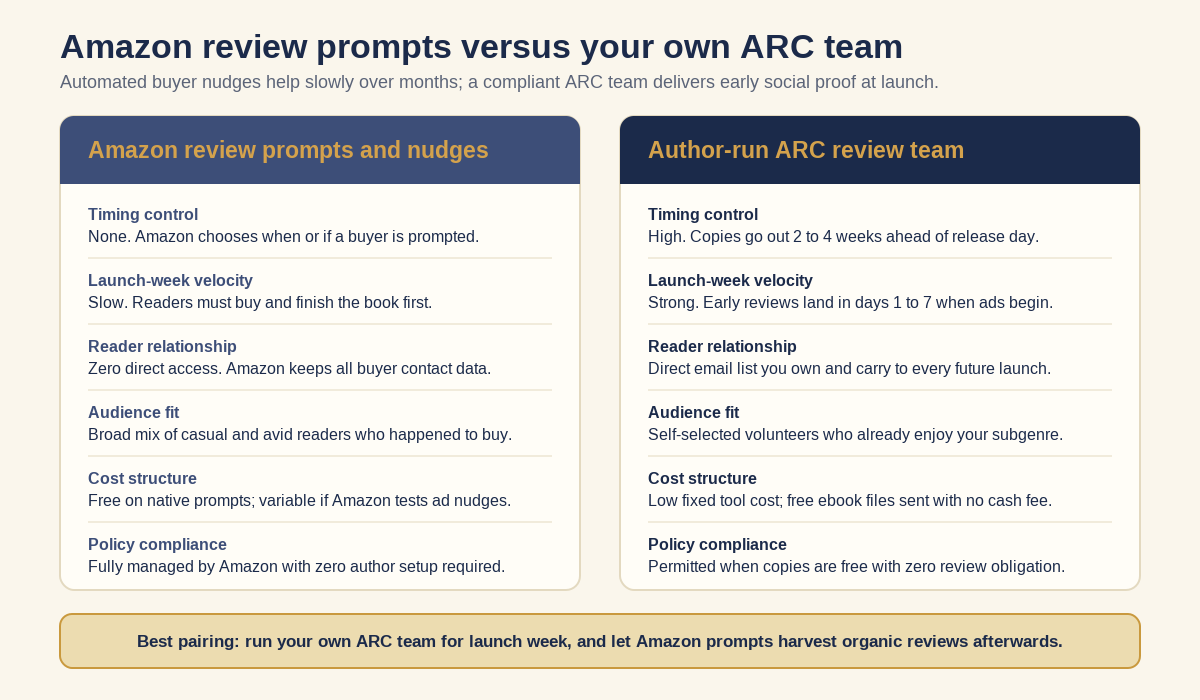
Comparing passive platform prompts against an author-managed ARC team across six operational dimensions makes the trade-off obvious. Neither channel replaces the other; each excels where the other is weakest.
| Dimension | Amazon review prompts | Author-run ARC review team |
|---|---|---|
| Timing control | None; Amazon decides if and when to prompt | High; files go out 2 to 4 weeks before launch |
| Launch-week velocity | Very slow; buyers must purchase and read first | Strong; early reviews arrive in days 1 to 7 |
| Reader relationship | Zero contact details; stays inside Amazon | Direct email list you own across every launch |
| Genre targeting | Broad mix of organic buyers | Self-selected fans of your exact subgenre |
| Verified Purchase badge | Yes, for qualifying retail orders | No, because advance copies are free |
| Cost structure | Free for native prompts; variable for paid tests | Free ebook files plus low fixed tool cost |
Why launch-week timing matters more than lifetime prompt volume
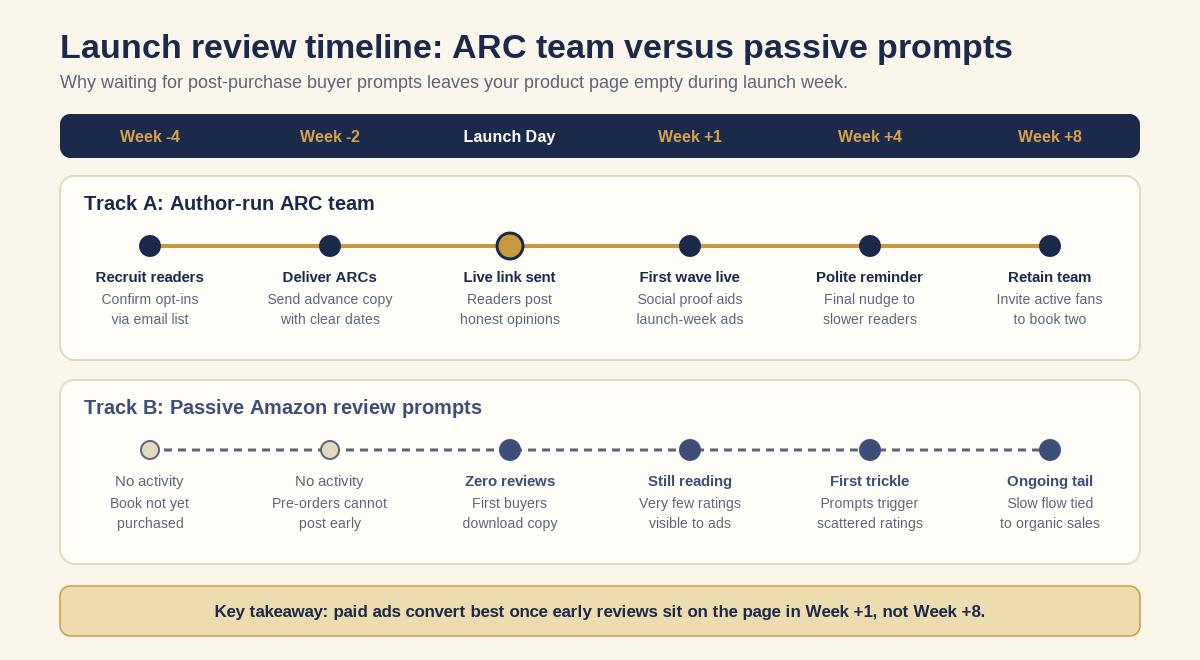
A book's first two weeks on sale shape both conversion rate and advertising economics. Cold shoppers arriving from an Amazon ad or a category bestseller list scan three elements in under five seconds: your cover, your opening blurb lines, and your review count. Sending paid clicks to a product page with zero reviews burns budget quickly because cautious readers wait for someone else to go first.
With passive Amazon review prompts alone, your book goes live on launch day with zero ratings. Even if your newsletter drives 50 sales on day one, most readers take one to three weeks to finish a full-length novel, and only a tiny fraction of finishers leave a written review. That means your page can sit near zero reviews throughout your entire launch promotion.
By contrast, an opt-in ARC team receives your formatted ebook two to four weeks before publication day. Readers finish the book on their own schedule ahead of launch and are ready to share honest thoughts as soon as the retail page opens for reviews. To calculate how large a reader group you need for your target launch count, see how many review readers you need for 20 launch-week reviews or plug your expected completion rate into the ARC reader calculator.
Worked arithmetic: yield and economics of both approaches
To illustrate the practical difference in numbers, examine a worked example for a new indie novel priced at $4.99. These figures are hypothetical assumptions used to show the mechanics clearly rather than guaranteed outcomes.
In Scenario A, you rely purely on organic sales and passive Amazon review prompts. Suppose your launch month produces 200 sales through a mix of organic discovery and early ads. If 3% of those buyers eventually respond to Kindle's end-of-book prompt or a follow-up Amazon email, you earn 6 reviews across weeks two through eight. During launch week itself, your product page displays zero to two reviews, depressing click-to-order conversion on every pound or dollar you spend promoting the book.
In Scenario B, you recruit 60 volunteer ARC readers from your mailing list and genre reader groups four weeks before launch. You distribute clean, watermarked digital copies at zero unit cost beyond your regular author toolkit. Suppose 35% of those volunteers finish the book and choose to post an honest review during launch week:
- Sixty opt-in readers at a 35% posting rate yield 21 honest reviews in days one through seven.
- When your paid ads and launch newsletter start driving cold traffic, shoppers immediately see 21 real reader perspectives alongside your cover and blurb.
- Once those launch-week buyers finish the novel in weeks two through eight, Amazon's native prompts begin adding Verified Purchase ratings on top of your ARC foundation, pushing the title cleanly past 30 total reviews.
- Because you own the email addresses of those 21 engaged ARC volunteers, you can invite them back for Book 2 without paying to acquire them all over again.
Over a three-book series, that compounding ownership matters even more than the reviews on Book 1. Every launch grows a warmer core group of genre fans who read early, spot lingering typos if you invite feedback beforehand, and talk about your books with friends.
Staying inside Amazon Community Guidelines with your ARC team
Running an ARC team safely requires absolute clarity on where Amazon draws the compliance line as of November 2026. The Alliance of Independent Authors and Amazon's own review policies draw a firm boundary between legitimate advance review copies and prohibited review manipulation.
Follow these non-negotiable compliance rules on every launch:
- Offer the advance copy completely free with zero obligation to leave a review of any kind.
- Never offer cash, gift cards, discounts, bonus chapters, raffle entries, or merchandise conditional on posting a review.
- Never ask for four-star or five-star ratings, and never tell readers to contact you privately instead of posting if they disliked the book.
- Never participate in author-to-author review swaps, paid review clubs, or groups that track and punish members who skip reviews.
- Keep close family members, household partners, and people who share your billing address or Wi-Fi network off your Amazon review team, as Amazon's automated systems frequently flag and delete linked accounts.
Keep your wording relaxed and transparent in every message: thank the reader for volunteering, provide a clean download link, mention the publication date, and invite them to leave an honest opinion if they have time. Our guide on running a review team without leaks or lost reviews covers file security, pacing, and list hygiene in detail.
Handling mixed or critical reviews without hurting your team
Genuine ARC teams will occasionally produce three-star or critical reviews, and that honesty actually strengthens buyer trust on your product page. Shoppers grow sceptical when every review on a new title reads like breathless five-star praise, whereas a balanced spread of thoughtful four-star and five-star ratings alongside the occasional three-star critique converts cold browsers cleanly. Never argue with a reviewer, remove a reader simply for leaving a lower rating, or reply publicly to customer reviews.
Instead, track your completion rate by recruitment source after every release. If volunteers recruited from your own back-matter mailing list post at 45% while signups from a general giveaway post at 12%, focus your next recruitment invite on warm subscribers who already finish your books. Quality of genre match beats raw headcount on every single launch.
Combining both channels into one repeatable launch routine
The smartest indie authors treat Amazon review prompts and an ARC team as a two-stage relay rather than an either-or choice. Put this five-step sequence on your launch calendar for every new release:
- Four to six weeks before launch, invite subscribers on your mailing list who actively enjoy your genre to opt in for your next ARC wave rather than blasting your entire list automatically.
- Two to four weeks before launch, deliver clean EPUB files via a dedicated ARC distribution page so readers can load the book onto their Kindle or tablet without wrestling with email attachments.
- On release day and again seven days later, send short, polite reminder emails with a direct link to the live retail page using tested wording from our review request email templates for readers.
- Inside the back matter of the published ebook, place a brief, warm two-sentence note right at the end of the final chapter thanking the reader and inviting an honest rating, right before Amazon's native Kindle prompt appears on the next tap.
- Two weeks after launch, remove bounced or chronically inactive addresses from your active ARC segment while thanking engaged readers and noting who would like early access to your next title.
You do not need a dozen separate subscriptions to run that workflow cleanly. If you want an author website, mailing list, ARC distribution, and direct sales in one place, Indie Author Toolchest costs $12.99 a month or $120 a year with a 14-day free trial and no card required, and direct sales switch on when you subscribe. Start recruiting your first twenty genre-matched ARC volunteers today so your next release never enters launch week waiting passively for an algorithm to ask buyers for a star rating.
Questions, answered
Are Advance Reader Copies allowed under Amazon review rules?
Yes, providing free Advance Reader Copies to genuine readers ahead of publication is permitted as long as there is zero obligation to leave a review and zero pressure to leave a positive rating. You must never pay cash, offer gift cards, or run review swaps in exchange for a review. Always state plainly in your ARC invitation that posting an honest review is completely optional.
Can indie authors trigger or schedule Amazon review prompts themselves?
No, Amazon controls when its native Kindle end-of-book rating pop-ups, post-purchase reminder emails, and experimental buyer review nudges appear. Authors cannot choose which buyers receive a prompt, edit the message wording, or time the prompt to match launch week. Your own mailing list and back-matter invitation are the only review requests whose timing you control directly.
How many ARC readers do I need to get 20 launch-week reviews?
Because busy volunteer readers rarely achieve a 100% completion rate, most indie authors recruit roughly 50 to 70 opt-in ARC readers to land 20 honest reviews during launch week. Actual completion rates vary with genre, word count, and how well you warm up your readers beforehand. Recruiting strictly from people who already read your genre improves follow-through far more than chasing big raw signup numbers.
Do ARC reviews show the Verified Purchase badge on Amazon?
No, an Advance Reader Copy given away free outside Amazon does not receive the Verified Purchase tag, though the review still counts toward your public star average and review total. Verified Purchase reviews come from readers who bought your book directly through Amazon and later responded to organic prompts or your back matter. A healthy product page benefits from ARC reviews in week one followed by Verified Purchase reviews over the months ahead.
Should I abandon Amazon review prompts if I build an ARC team?
Not at all, because native Amazon prompts run automatically in the background at zero effort to you. Your ARC team solves the cold-start problem during launch week so paid ads and organic browsers see real social proof immediately. Over the long tail of the book's life, Amazon's post-purchase prompts and your own end-of-book request keep fresh Verified Purchase ratings trickling in.